Articles
Is my tree dangerous?
The signs that a tree may be unsafe, and what to do if you are worried about one.
Most trees are safe, and a tree that looks fine from the road usually is. But the signs that matter are often small and low down, and a handsome crown can sit on a failing base. These are the things I look for first.
Cracks and splits
Cracks in the stem or at the base are worth taking seriously, especially where one has opened recently. A fresh crack shows pale, unweathered wood. Cracks that run along the stem, or open and close as the tree moves, mean the wood is no longer holding together as it should.
Fungus on the trunk or roots
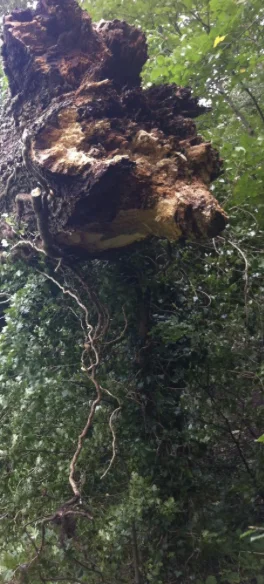
Brackets, mushrooms or a hard black crust at the base or on the roots can mean the wood inside is decaying. Some of these fungi rot a tree from the inside while the outside still looks solid, so a tree can fail with little warning. We write about three of them in our articles on a beech that blew over and honey fungus in a giant redwood.
A lean, or movement at the base
A tree that has always leaned is often fine. A tree that has started to lean, or has raised or cracked soil on one side, has probably had its roots disturbed. Roots cut by trenching or building work are a common cause.
Dead branches and thin foliage
Dead branches, dieback in the crown and unusually sparse leaves can point to a problem below ground. Ash dieback is the most common cause in this area, and it makes the wood brittle.
A lopsided or heavy crown
A crown that is heavily weighted to one side, or hangs out over a road, a path or a house, puts extra load on the stem and roots, particularly in a gale.
How much it matters depends on what is underneath
The same defect is a different problem in a field and over a road. A cracked tree in the middle of a pasture is rarely urgent. A cracked tree beside a house or a busy lane is. That is why we look at what the tree could hit, as well as the tree itself.
What to do
If you think a tree is an immediate danger, keep people and vehicles away from it and get advice quickly. Do not cut it down yourself. Check first whether it is protected, because that decides whether consent or notice is needed (see Is my tree protected?). For anything that is not urgent, a survey will tell you which trees need work and which can be left alone.
If you are worried about a tree, get in touch with the address and a few details, or read more about our tree surveys.
Related: Is my tree protected? · Why have a tree survey? · A copper beech beside a road · Consultancy
Tell us about the trees.
Call or email with the site and the question. We will tell you what is needed and what it will cost.