Articles
Giant redwood and honey fungus.
A survey of a Victorian garden in the Lake District showed how honey fungus can kill a giant of a tree.
Giant redwoods (Sequoiadendron giganteum) are among the tallest trees in Britain, reaching up to 54 metres. One in Perthshire has a trunk about 4 metres across and over 12 metres round, having grown to that size in only 150 years. They turn up in stately homes and old gardens.
Very few giant redwoods have been blown over in storms. Their weakness is in the branches, which can split in wind and leave dangerous "hazard beams" hanging in the crown.
What we found in the Lake District
We surveyed an old Victorian property in Cumbria with large gardens. Among its trees were two big Atlantic cedars and three large giant redwoods.
- The first redwood, well over 2.5 metres round, had recently died. It showed signs of honey fungus (Armillaria mellea).
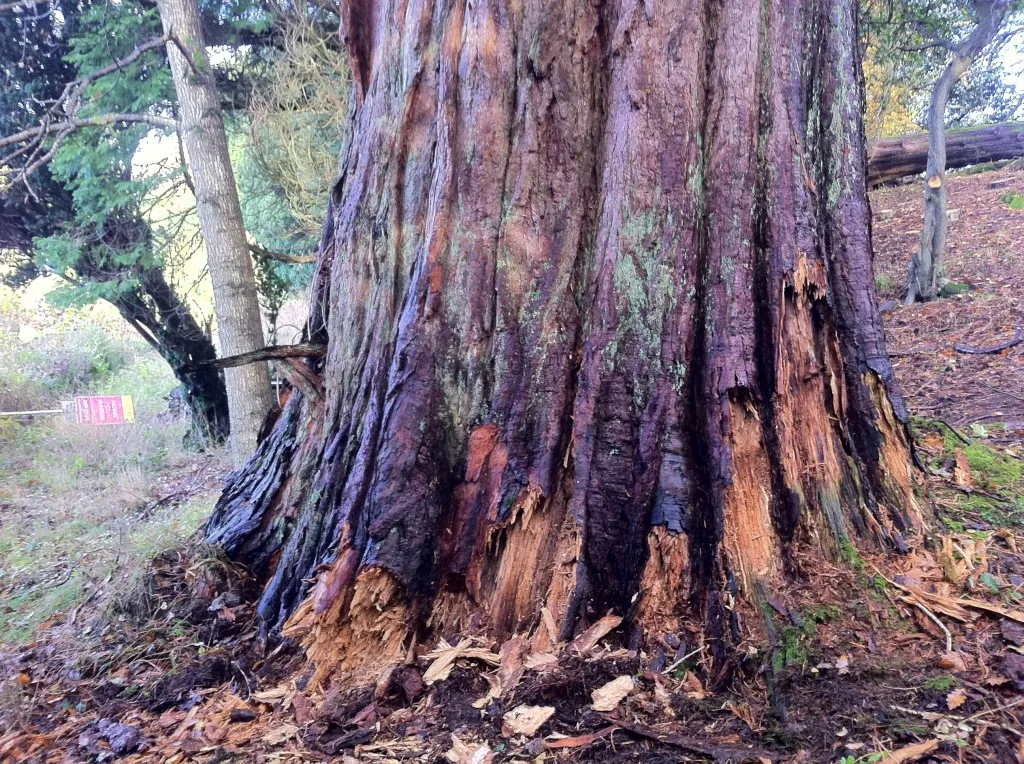
- The second redwood had extensive decay. More than 75% of the bark at the base was dead, and one side was heavily decayed down into the buttress roots. Yet it still had a full green crown, with no dieback.
Around the decayed area we found honey fungus rhizomorphs, which are root-like strands, under the bark and in the decayed wood. The fungus uses them to travel between trees and decaying wood while it searches for new hosts.
Why the tree could not fight back
Some species can wall off decay, keeping it to a small area. Giant redwood wood has very little ability to do this. A vigorous tree can also build extra wood, called reaction wood, where its stem is weak, and the second redwood had done so on one side, giving the stem a lopsided shape. But with about 75% of the bark killed, there was too little living tissue left to build it properly.
What to take from it
A green crown is not proof that a tree is healthy. The damage here was at the base, where it is easy to miss unless someone looks. Honey fungus kills roots and sapwood, and the biggest trees can be among the first to be lost.
Related: Why have a tree survey? · Veteran trees
Tell us about the trees.
Call or email with the site and the question. We will tell you what is needed and what it will cost.