
Articles
How QTRA measures tree risk.
What Quantified Tree Risk Assessment is, and how it turns a tree’s condition into a number you can act on.
Quantified Tree Risk Assessment, or QTRA, is a way of putting a number on the risk a tree poses. It was developed in the UK and is now one of the most widely used methods here for managing tree safety, from single garden trees to estates, schools and churchyards.
Why use numbers?
Most trees are safe, and a few are not. The difficulty is telling which is which, and then deciding how much work is reasonable. Describing a tree as "low risk" or "high risk" leaves that open to opinion. QTRA gives a figure, so the decision can be explained to an owner, an insurer or a council, and defended if it is ever questioned.
How it works
Three things are assessed for each tree:
- The target. What could be hit if the tree, or part of it, fell: a road, a path, a house, a garden, and how often people are there.
- The size of the part that could fail. A twig is not a limb, and a limb is not a whole tree.
- The probability of failure. How likely it is that the tree or branch fails within the next year, judged from its condition.
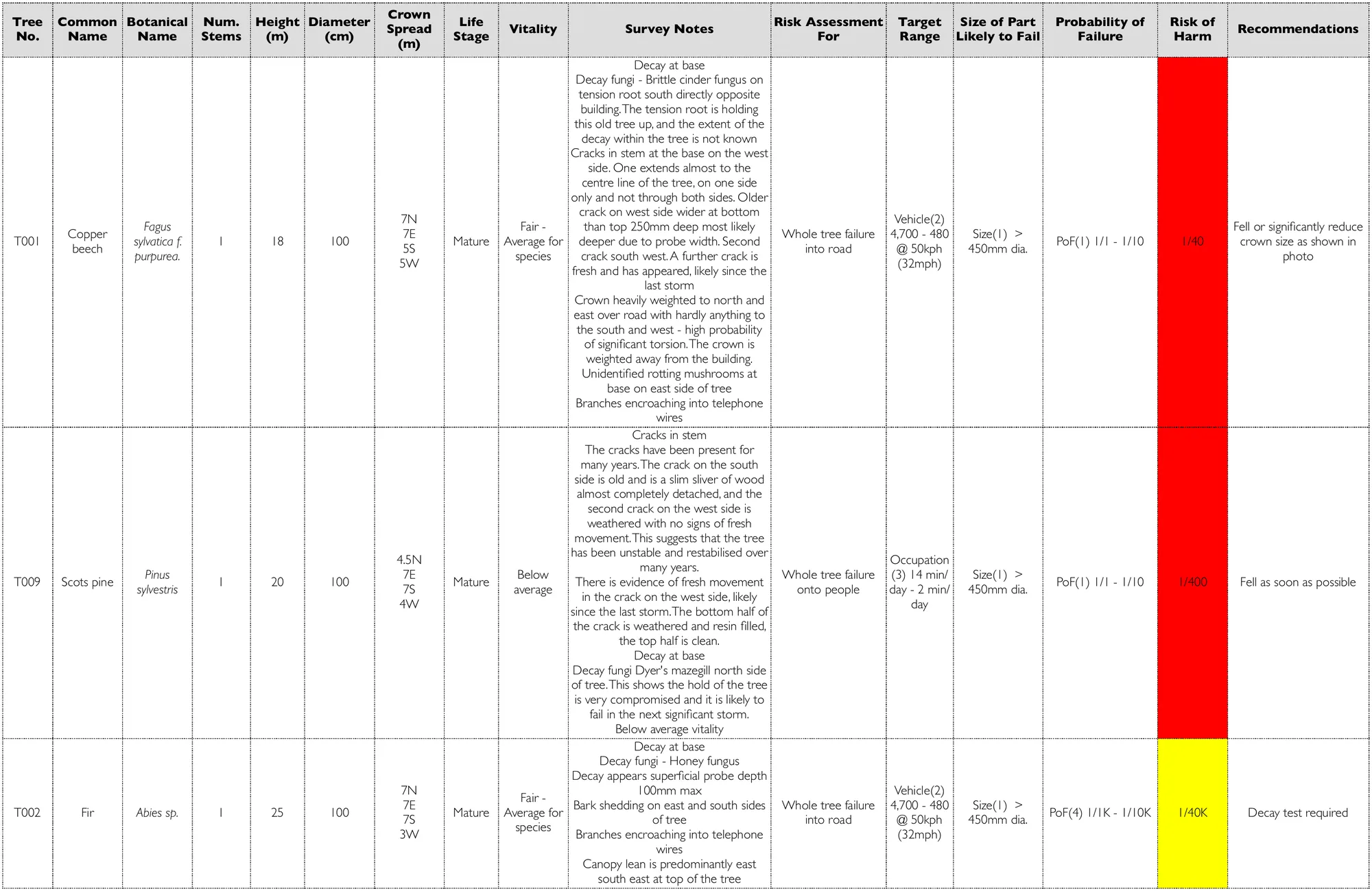
Multiplying the three together gives the Risk of Harm: the chance, in any one year, of a person being killed by that tree. A figure of 1 in 10,000 or greater is not acceptable, and the tree needs work as soon as possible. Lower figures are tolerable or broadly acceptable, and the work can be a matter of judgement and budget.
What you get
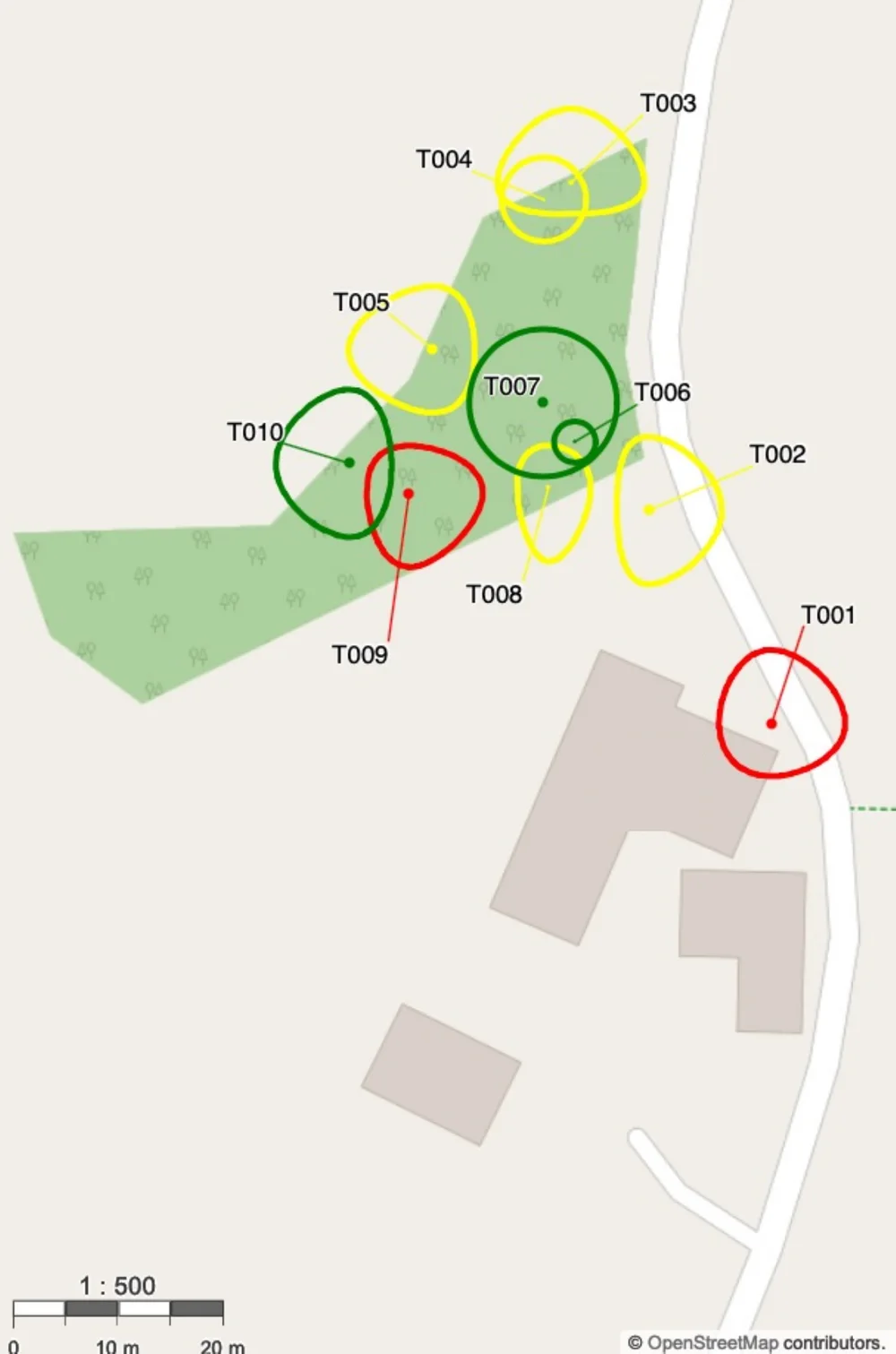
You receive a plan with every tree numbered and coloured by its risk of harm, and a schedule giving the findings and recommendations for each one. The works are limited to the trees that need them, so a tree that is safe is left alone.
Where it is used
We use QTRA for trees beside roads and paths, around houses, on estates and in woodland open to the public, and wherever an owner needs to show they have taken reasonable care of their trees. You can see an example in our article on a copper beech beside a road.
Related: A copper beech beside a road · Tree surveys: why bother? · Consultancy
Tell us about the trees.
Call or email with the site and the question. We will tell you what is needed and what it will cost.